抗戰記憶的建構 I
Construction of Collective Memory of the War of Resistance against Japan

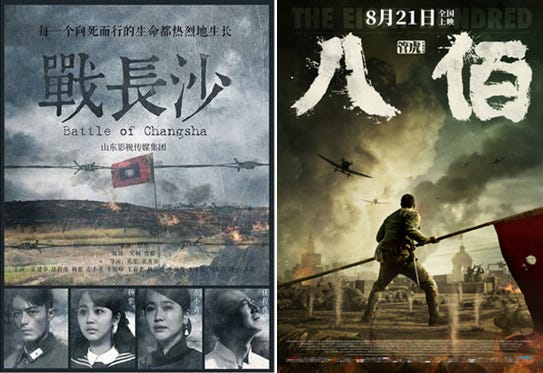
2024 年 5 月,由劉和平編劇並導演的大製作電影《援軍明日到達》,在預告片已發布且正式定檔的情況下,竟然無預警地從所有平台「消失」,這勾起了我的強烈好奇。
做了一番功課後,我的結論是:這部片若是放在十年前(2014 年,也是電視劇《戰長沙》播出的年份;事實上,該劇也描寫過衡陽保衛戰與方先覺投降),或許能頂著「劉和平作品」的光環風光上映。
每當我在 YouTube 上看到翻牆而來的大陸網友,信誓旦旦地宣稱「大陸現在很尊重歷史」——理由是歷史遺址或影視作品中都能見到國軍與青天白日旗——我總忍不住翻白眼。暫且不論所謂「尊重歷史」的內涵為何,我也不覺得這些評論者全是小粉紅,但我只想說:習時代的官方抗戰論述,早已與胡溫時代相比發生了劇烈轉向。現在是 2020 年代,不是 2000 年代,請與時俱進好嗎?現在官方早已不再講「正面戰場」,只剩下「中流砥柱」了。
中共官方對於抗戰「公共記憶」的建構,絕非鐵板一塊。自 1949 年建政以來,這套敘事幾經轉向,在不同時期為政權的合法性提供支撐。
官方自然企圖壟斷公共記憶,但「官方」這台國家機器由不同的行動者(actors)組成,論述並非永遠一致;與此同時,民間、社會與市場的力量,也各有其試圖發揚光大的版本。
2025 年回國後,我在各地遊歷期間,特別留意了抗戰相關的展覽與紀念活動。因此,我想在此開啟一個系列,記錄我在田野調查中發現的「主旋律」與「雜音」之間的張力。
在進入具體案例之前,我想先附上一段背景介紹(寫於 2024 年):關於中共對抗戰敘事的三個階段性轉變。
Construction of Collective Memory of the War of Resistance against Japan
Xi Jinping staged his first military parade on September 3, 2015, a date designated the previous year as the National Victory Day of the Chinese People’s War of Resistance Against Japanese Aggression; he also changed the deeply ingrained both official and popular notion of the 8-Year War (1937-1945) of Resistance to the 14-Year War of Resistance (1931-1945), and the new timeframe of the war was quickly adopted in school textbooks by 2017. This shows that the War of Resistance, which is approaching its 80th anniversary, remains an important site for the Chinese state and its leadership to claim legitimacy and construct national identity.
In 2019, the release of the blockbuster film The Eight Hundred, which tells the story of the Nationalist (KMT) Revolutionary Army’s defense of a warehouse during the bloody Battle of Shanghai in 1937, was canceled. However, the film, widely believed to have at least been re-edited to give less prominence to the national flag of Republic of China, was released the following year and became a huge commercial success (it was the top-grossing film in China in 2020), despite harsh attacks and accusations of historical revisionism from the Maoist left and some Communist Youth League outlets. The film’s idiosyncratic journey shows that the state tightly controls, but does not monopolize, the construction of the collective memory of the war; moreover, multiple non-state actors are also active in shaping and claiming war memories. Since 1949, the landscape of collective war memory has evolved drastically.
The relevance, selective remembering and forgetting of the war have undergone significant changes in the official narratives of the Chinese Communist Party (CCP). During the Mao era, the War of Resistance did not figure prominently in the CCP’s construction of its legitimacy, which was based on the CCP leading the revolution to liberate the Chinese people from imperialism, feudalism, and bureaucrat capitalism. During this period, there was a top-down amnesia about Japanese wartime atrocities, dismissal of the contribution of the allegedly counterrevolutionary KMT government and army, and emphasis on the heroic CCP-led resistance; the official line favored a victorious narrative.
In the post-Mao era, beginning in the 1980s, the War of Resistance became increasingly important in the state’s construction of national identity and the legitimacy of CCP rule as socialist ideology gradually lost its appeal. The state actively constructed official memories by building museums, such as the Memorial Hall for the Victims of the Nanjing Massacre by Japanese Invaders in Nanjing and the September 18 History Museum in Shenyang, and commemorating dates that represented national humiliation. In stark contrast to the previous period, the state’s construction of war memory since the 1980s emphasized Japanese violence and Chinese suffering; the official narrative accentuated the theme of victimhood rather than victory. After the crackdown on the democratic movement in 1989, patriotic education of schoolchildren became a key state policy, and the War of Resistance became the main source of patriotism. However, patriotism was conceived as a way to bolster popular support for the CCP and its goals of economic development, national unity, and state-strengthening, all of which provided legitimacy to the post-Mao, post-revolutionary CCP regime, rather than to foster populist anti-Japanese nationalism.
It is worth noting that since the 1980s, the KMT’s contribution to the War of Resistance has gradually been officially recognized. For the CCP, this recognition serves the goal of improving relations with the KMT in Taiwan and ultimately unifying Taiwan. Especially during the Hu-Wen administration, the official central line has been to acknowledge the important role of the KMT on the front lines, but to maintain the Maoist discourse that the CCP is the bulwark of the war effort against Japanese invasion.
Since Xi took power, the official state narrative has taken another turn. Breaking with the trope of victimhood, the new central line now emphasizes triumph and greatness: The CCP united and led the morally righteous and strong Chinese people to win a just and global war against fascism. The extension of the war’s timeframe from eight to fourteen years emphasizes the CCP’s role in mobilizing national resistance at the earliest stage, and once again the KMT’s role seems to have receded into the background. Emphasizing the important place of the War of Resistance in the global struggle against fascism portrays China as a responsible power, especially to the world, and justifies China’s assertive foreign policy.
Since the 1980s, the relationship between state and society has changed, and the social space has opened up, but it is limited by the state. More actors, such as scholars, amateur historians/history activists, commercial media, have played an active role in reshaping the collective memory of the war. More stories and histories of individual and local experiences that deviate from the grand official narrative have emerged and entered public space, such as the private Jianchuan Museum. However, the bottom-up collective memory is not necessarily an alternative to the official line, but still pokes holes in the official narrative from time to time and faces censorship and repression, such as the film The Eight Hundred. The War of Resistance will remain a fiercely contested site for what can be remembered and what should be forgotten.
Literature
Chang, Vincent K. L. “Exemplifying National Unity and Victory in Local State Museums: Chongqing and the New Paradigm of World War II Memory in China.” Journal of Contemporary China 31, no. 138 (2022): 977–92.
Denton, Kirk A. “The Jianchuan Museum: The Politics of War Memory in a Private Chinese Museum.” In Remembering Asia’s World War Two, edited by Mark R. Frost, Daniel Schumacher, and Edward Vickers, 72–106. London: Routledge, 2019.
Diamant, Neil J. “Conspicuous Silence: Veterans and the Depoliticization of War Memory in China.” Modern Asian Studies 45, no. 2 (2011): 431–61.
Lary, Diana. “Memory Times, Memory Places: Public and Private Commemoration of War in China.” In Remembering Asia’s World War Two, edited by Mark R. Frost, Daniel Schumacher, and Edward Vickers, 56–71. London: Routledge, 2019.
Mitter, Rana. China’s Good War: How World War II Is Shaping a New Nationalism. Cambridge, MA: Harvard University Press, 2020.
Reilly, James. “Remember History, Not Hatred: Collective Remembrance of China’s War of Resistance to Japan.” Modern Asian Studies 45, no. 2 (2011): 463–90.
Waldron, Arthur. “China’s New Remembering of World War II: The Case of Zhang Zizhong.” Modern Asian Studies 30, no. 4 (1996): 945–78.
Wang, Yi, and Matthew M. Chew. “State, Market, and the Manufacturing of War Memory: China’s Television Dramas on the War of Resistance against Japan.” Memory Studies 14, no. 4 (2021): 877–91.